
Imagine working hard for a team project while no one acknowledges your effort. After a while, you may feel that others assume your support will always be there—they assume your support will always be there without appreciation. This phrase appears often in personal relationships, workplaces, and everyday conversations because it captures a common human experience: being overlooked despite consistent value.
“Take for granted” matters in modern communication because language shapes relationships. In professional settings, casual conversations, or digital communication, using this phrase—or choosing a better alternative—can influence how your message is perceived. Sometimes it sounds reflective and honest; other times, it may sound accusatory. Understanding its meaning, tone, and alternatives helps you communicate more clearly and professionally.
What Does “Take For Granted” Mean?
To take for granted means to assume that someone or something will always be available, reliable, or true without properly appreciating its value or importance. It can also mean accepting something as fact without questioning or examining it.
Origin & History of This Expression

The expression “this phrase” traces back to English usage from the 16th and 17th centuries, when grant referred to something accepted or given as true. Early uses focused on accepting facts without proof.
Over time, the meaning expanded beyond facts into emotional and social contexts. By the 19th century, people commonly used the phrase to describe relationships where someone’s efforts, presence, or kindness became expected rather than appreciated.
Today, the expression carries both intellectual and emotional meaning. You can accept an assumption without question, or you can fail to appreciate a person. That dual usage makes it especially powerful in modern communication.
Synonyms & Alternatives by Tone
Professional & Neutral Alternatives
- Assume without question
- Overlook the value of
- Underappreciate
- Fail to acknowledge
- Regard as guaranteed
Polite & Supportive Alternatives
- Not fully appreciate
- Miss the value of
- Become accustomed to
- Forget to recognize
- Lose sight of importance
Encouraging & Reassuring
- Value more consciously
- Appreciate more deeply
- Be mindful of
- Recognize consistently
- Stay grateful for
Casual, Playful & Idiomatic Alternatives
- Get too comfortable
- Stop noticing
- Sleep on
- Treat as a given
- Expect by default
When Should You Use “Take For Granted”?
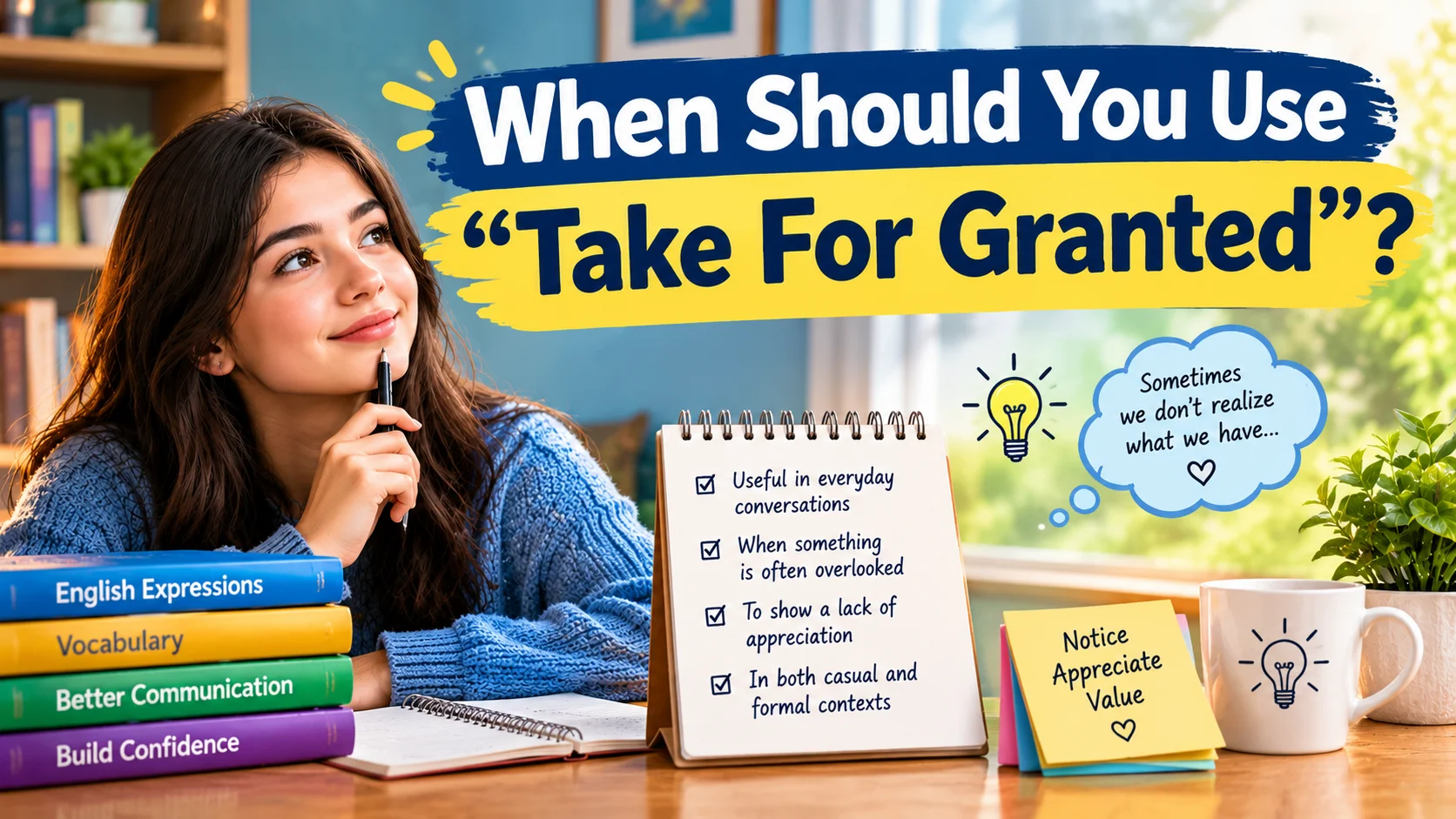
Use this phrase when discussing unappreciated effort, overlooked value, or unchecked assumptions.
Professional Settings
Useful in feedback conversations, leadership discussions, and workplace communication.
Example:
“We shouldn’t overlook customer loyalty.”
Casual Conversations
Common in friendships, family relationships, and daily interactions.
Example:
“I realized I wasn’t fully appreciating my parents.”
Writing, Presentations, Digital Communication
Helpful in blogs, presentations, and social media where appreciation or awareness is the theme.
When It Is Especially Effective
The phrase works best when highlighting:
- Lack of appreciation
- Hidden value
- Unquestioned assumptions
When Should You Avoid This Expression?
Avoid the phrase in highly sensitive or technical contexts.
Overly Formal Situations
Legal or contractual writing requires precise wording.
Legal, Academic, or Sensitive Contexts
Use more specific language such as “assume without evidence.”
Situations Where Nuance May Be Lost
Sometimes the wording sounds accusatory.
Example to avoid:
“You don’t appreciate my efforts.”
This may trigger defensiveness.
Is This Expression Professional, Polite, or Casual?
This expression sits in the middle of the formality spectrum.
- Professional: Yes, when discussing assumptions or business risks
- Polite: Moderately, depending on delivery
- Casual: Very common in everyday speech
Emotional subtext matters. When directed at people, it often implies disappointment or emotional hurt.
Pros and Cons of Using This Expression
Advantages
- Clarity — instantly understandable
- Efficiency — conveys complex emotion quickly
- Accessibility — widely recognized in English
Potential Drawbacks
- Oversimplification — may miss nuance
- Tone mismatch — can sound blaming
- Repetition — overuse reduces impact
Real-Life Examples by Context
“Let’s not overlook our loyal clients as competition increases.”
Meeting
“We cannot assume market stability this quarter.”
Presentation
“Many brands overlook consumer trust.”
Conversation
“I didn’t realize I was overlooking my health.”
Social Media
“Don’t overlook the people who support you.”
“Take For Granted” vs Similar Expressions (Key Differences)
| Phrase | Meaning Difference | Tone Difference | Best Use Scenario |
|---|---|---|---|
| Underestimate | Focuses on judging too low | Neutral | Skills or risks |
| Overlook | Missing something important | Professional | Reports, analysis |
| Assume | Believing without proof | Neutral | Logic, decisions |
| Underappreciate | Lack of appreciation | Emotional | Relationships |
| Treat as a given | Expect automatically | Casual | Daily conversation |
Common Mistakes & Misuse
Overuse
Repeating the phrase weakens emotional impact.
Incorrect Context
Not ideal for precise technical writing.
Contradictory Usage
Avoid saying someone is both deeply valued and overlooked without explanation.
Cultural Misunderstandings
ESL learners may confuse appreciation with entitlement.
Psychological Reasons People Use This Expression
Cognitive Load Reduction
Humans conserve mental energy by automating expectations.
Trust and Authority Signals
Repeated reliability creates assumptions.
Attention Economy
People focus on urgent issues over stable ones.
Modern Communication Habits
Fast-paced digital life increases unconscious assumptions.
US vs UK Usage
In both the United States and the United Kingdom, the expression is common and widely understood.
- US: Frequently used in workplace and self-help discussions
- UK: Common in personal and reflective conversation
UK speakers may slightly favor softer alternatives in formal contexts.
This Expression in Digital & Modern Communication
Emails
Used in leadership and customer retention communication.
Slack / WhatsApp
Common in team culture discussions.
Social Media
Popular in motivational content.
AI-Generated Summaries
Frequently appears in emotional intelligence or communication advice.
Linguistic & Communication Insight
Emotional Weight & Subtext
Native speakers often hear disappointment, neglect, or regret behind this expression.
Direct vs Indirect Phrasing
The expression feels direct. Softer alternatives reduce tension.
Professional Communication Perspective
In workplaces, this wording can signal culture issues around recognition.
Pragmatic Reasons for Alternatives
Experienced communicators often choose softer wording to reduce defensiveness.
Social Signaling
Word choice influences trust, empathy, and authority.
Tone & Context Guidance
Use carefully when addressing people directly.
Meaning, Usage & Examples for Each Alternative
Underappreciate
Meaning: Fail to recognize value
Why This Phrase Works: Less accusatory
Real-World Usage Insight: Common in feedback discussions
Best Use: Professional communication
Avoid when: Informal joking.
Tone: Neutral-emotional
US vs UK Usage: Common in both
Example (Meeting): “We may be underappreciating how much support operations provides.”
Overlook the Value Of
Meaning: Miss importance
Why This Phrase Works: Gentle wording
Real-World Usage Insight: Good for reports
Best Use: Business analysis
Avoid When: Emotional argument.s
Tone: Professional
US vs UK Usage: Equal
Example (Email): “We should not overlook the value of customer retention.”
Fail to Acknowledge
Meaning: Not recognize contribution
Why This Phrase Works: Precise
Real-World Usage Insight: Common in HR language
Best Use: Performance reviews
Avoid when: Casual chat.
Tone: Formal
US vs UK Usage: Common
Assume Without Question
Meaning: Accept automatically
Why This Phrase Works: Highlights assumption.
Real-World Usage Insight: Common in academic writing
Best Use: Analysis
Avoid when: Emotional conversation.
Tone: Formal
Treat as a Given
Meaning: Expect automatically
Why This Phrase Works: Conversational
Real-World Usage Insight: Natural speech
Best Use: Daily communication
Avoid when: Formal reports.
Tone: Casual
Become Too Comfortable
Meaning: Stop noticing value
Why This Phrase Works: Softens blame
Real-World Usage Insight: Relationship discussions
Best Use: Personal conversations
Avoid When: Contracts
Tone: Friendly
Overestimate Reliability
Meaning: Trust consistency too much
Why This Phrase Works: Practical
Best Use: Risk management
Avoid When: Emotional discussions.
Tone: Professional
Forget to Recognize
Meaning: Miss appreciation
Why This Phrase Works: Gentle and empathetic
Best Use: Coaching
Tone: Warm
Lose Sight of Importance
Meaning: Stop noticing significance
Why This Phrase Works: Reflective
Best Use: Presentations
Tone: Thoughtful
Stop Noticing
Meaning: Become blind to value
Why This Phrase Works: Simple language
Best Use: Casual speech
Tone: Casual
Expect by Default
Meaning: Assume automatically
Why This Phrase Works: Modern wording
Best Use: Workplace discussions
Tone: Neutral
Miss the Value Of
Meaning: Fail to appreciate
Why This Phrase Works: Accessible to ESL learners
Best Use: Teaching
Tone: Friendly
Neglect to Appreciate
Meaning: Not show appreciation
Why This Phrase Works: Clear emotional nuance
Best Use: Relationships
Tone: Warm-formal
Assume It Will Always Be There
Meaning: Expect permanence
Why This Phrase Works: Highly relatable
Best Use: Motivational writing
Tone: Emotional
Disregard Importance
Meaning: Ignore significance
Why This Phrase Works: Strong wording
Best Use: Formal criticism
Tone: Strong
Comparison Table of 10 Best Alternatives
The best alternatives depend on whether you need a professional, emotional, or casual tone. Some phrases soften criticism, while others emphasize assumptions or lack of appreciation.
| Phrase | Meaning | Best Use | Worst Use | Tone | US vs UK Usage |
|---|---|---|---|---|---|
| Underappreciate | Not valuable enough | Feedback | Humor | Neutral | Equal |
| Overlook the Value Of | Miss importance | Business | Casual chat | Professional | Equal |
| Fail to Acknowledge | Not recognize | Reviews | Friendly talk | Formal | Equal |
| Treat as a Given | Expect automatically | Daily speech | Legal docs | Casual | Slight US |
| Forget to Recognize | Miss appreciation | Coaching | Technical writing | Warm | Equal |
| Lose Sight of Importance | Stop noticing value | Presentations | Texting | Thoughtful | Equal |
| Stop Noticing | Ignore over time | Casual talk | Reports | Casual | Equal |
| Miss the Value Of | Fail to appreciate | Teaching | Formal law | Friendly | Equal |
| Neglect to Appreciate | Lack gratitude | Relationships | Humor | Warm | Equal |
| Assume It Will Always Be There | Expect permanence | Motivation | Technical docs | Emotional | Equal |
Conclusion
The expression “this phrase” remains one of the most useful expressions in English because it captures a universal human tendency: becoming so familiar with something valuable that we stop noticing or appreciating it. Whether used in personal relationships, workplace communication, or everyday conversation, the expression highlights both assumption and lack of appreciation with strong emotional clarity. Understanding when to use it—and when to choose a softer alternative such as underappreciate or overlook the value of—can significantly improve communication. In professional settings, thoughtful word choice helps reduce defensiveness and encourages collaboration. For ESL learners and writers, mastering this expression also improves fluency and nuance. Ultimately, language is not just about vocabulary; it shapes perception and relationships. Recognizing what we often overlook can improve gratitude, strengthen communication, and create more meaningful personal and professional connections.
FAQs
What does this expression mean?
This expression means assuming that someone, something, or a situation will always be available, reliable, or true without appreciating its value. It can also refer to accepting something as fact without questioning it. The phrase often highlights unnoticed importance or lack of appreciation.
Is this a negative phrase?
Generally, yes. The phrase usually carries a negative emotional tone because it suggests neglect, entitlement, or lack of gratitude. However, in academic or logical contexts, it can be neutral when discussing assumptions accepted without proof or analysis.
Can this expression be used in professional communication?
Yes, it is commonly used in workplaces, especially when discussing customer loyalty, employee contributions, or business risks. In formal communication, professionals may choose alternatives like underappreciate or overlook the value to sound more diplomatic and constructive.
What are the best synonyms for this expression?
Some strong alternatives include underappreciate, overlook, treat as a given, fail to acknowledge, and assume without question. The best synonym depends on context, tone, and whether you want to sound professional, casual, or emotionally expressive.
Is this expression common in everyday English?
Yes, it is widely used in both spoken and written English. Native speakers commonly use it in conversations about relationships, work, family, gratitude, and personal reflection, making it a valuable phrase for ESL learners to understand and use.
Can you use this expression for objects or situations?
Absolutely. People often say they overlooked their health, time, financial stability, or opportunities. The concept applies not only to people but also to resources, privileges, and circumstances that feel consistently available.
Does this expression sound rude?
Not always, but tone matters. Saying “You don’t appreciate my efforts” can feel accusatory and emotionally charged. In sensitive conversations, softer alternatives may help communicate the same message without sounding confrontational or overly critical.
How is this expression used in writing?
Writers use the expression in essays, blogs, speeches, and professional content to emphasize overlooked value or hidden assumptions. It is especially effective in persuasive or reflective writing because readers quickly understand its emotional and practical meaning.
Is there a difference between US and UK usage?
The expression is common in both the United States and the United Kingdom. Usage is very similar, although British speakers may occasionally prefer slightly softer wording in formal or sensitive professional contexts.
Why is this expression important in communication?
This expression matters because it expresses both emotional awareness and practical insight. Recognizing when people or resources are being overlooked improves empathy, appreciation, and communication, helping build stronger personal relationships and healthier workplace dynamics.

Daniel K is an English language writer focused on making grammar, vocabulary, and everyday communication simple and practical. He creates clear, engaging content that helps students, professionals, ESL learners, and English enthusiasts improve their language skills. His work focuses on explaining confusing words, phrases, and expressions in an easy-to-understand way, helping readers communicate more naturally, accurately, and confidently.
