
Imagine you’re in a heated argument at school, joking with friends, or watching an old TV show when someone blurts out, “Eat my shorts!” The phrase instantly sounds rebellious, sarcastic, and a little rude. But what does it actually mean—and why has it remained part of pop culture for decades?
“Eat my shorts” is more than a quirky insult. It reflects tone, attitude, and social dynamics in communication. In modern English, understanding expressions like this helps professionals, students, ESL learners, and writers recognize when language is humorous, aggressive, playful, or inappropriate. Knowing better alternatives also helps you communicate more clearly and avoid tone mismatches in professional or sensitive situations.
What Does “Eat My Shorts” Mean?
“Eat my shorts” is a slang expression used to show defiance, dismissal, mockery, or disrespect, often toward someone giving orders, criticism, or unwanted advice. It usually communicates “go away,” “I don’t care,” or “I refuse to listen,” in a rude or sarcastic way.
Origin & History of “Eat My Shorts”

The phrase gained mainstream popularity through The Simpsons, especially through the fictional character Bart Simpson, whose rebellious catchphrase became iconic in the early 1990s.
However, the phrase predates the show. Informal slang versions appeared in American youth culture during the 1970s and 1980s, especially in school environments. It was often used as a comic insult rather than a literal statement.
Over time, its meaning evolved:
- Early usage: rebellious teen slang
- 1990s: pop-culture catchphrase
- Modern usage: nostalgic, humorous insult
Today, many people recognize it as retro slang rather than everyday speech.
Synonyms & Alternatives by Tone
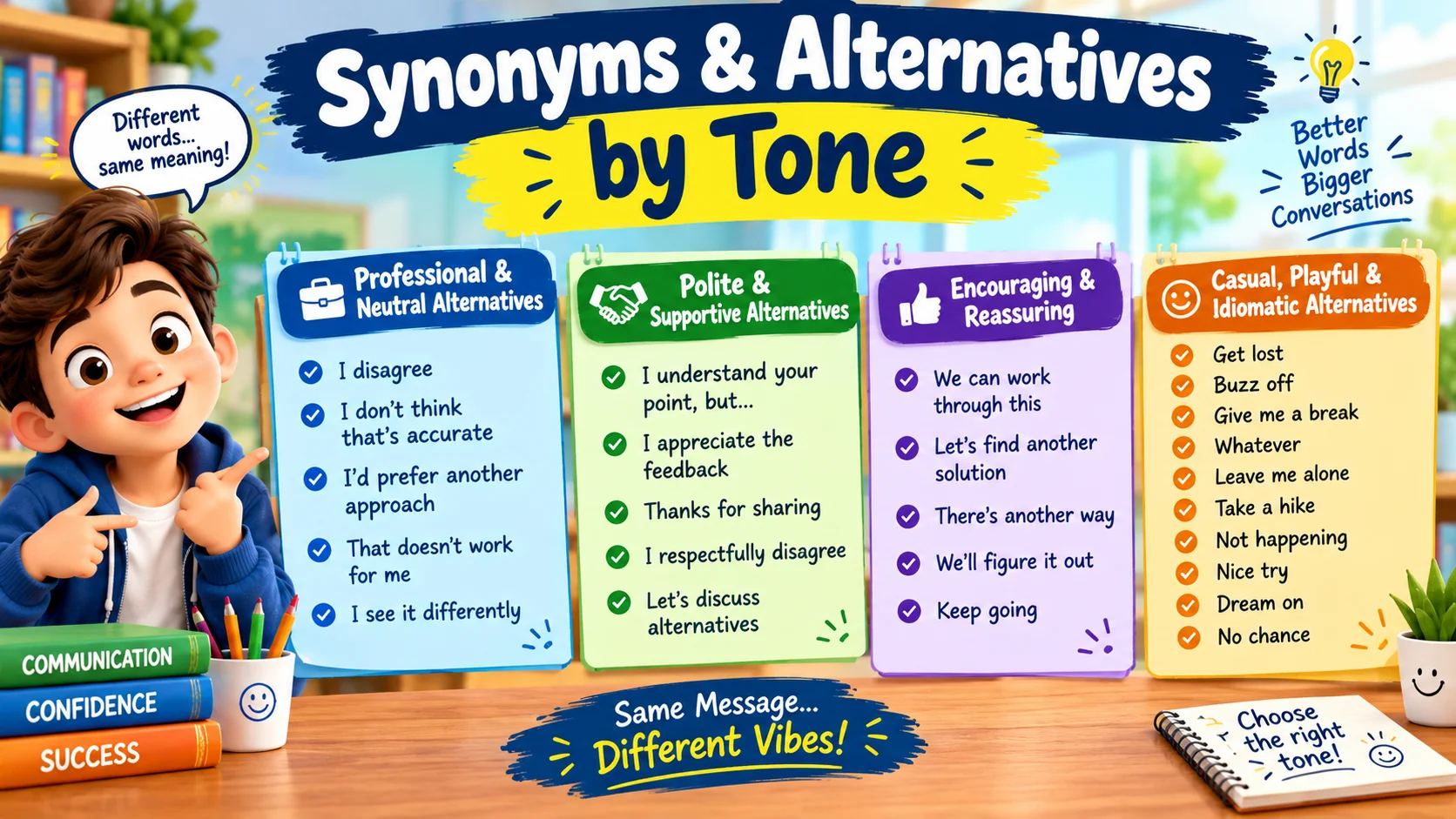
Professional & Neutral Alternatives
- I disagree
- I don’t think that’s accurate
- I’d prefer another approach
- That doesn’t work for me
- I see it differently
Polite & Supportive Alternatives
- I understand your point, but…
- I appreciate the feedback
- Thanks for sharing
- I respectfully disagree
- Let’s discuss alternatives
Encouraging & Reassuring
- We can work through this
- Let’s find another solution
- There’s another way
- We’ll figure it out
- Keep going
Casual, Playful & Idiomatic Alternatives
- Get lost
- Buzz off
- Give me a break
- Whatever
- Leave me alone
- Take a hike
- Not happening
- Nice try
- Dream on
- No chance
When Should You Use “Eat My Shorts”?
This phrase works mostly in casual, humorous, or fictional contexts.
Professional Settings
Avoid it almost entirely.
Casual Conversations
May work among close friends who understand sarcasm.
Writing, Presentations, and Digital Communication
Can be used for humor, nostalgia, or pop-culture references.
Especially Effective When
- Joking
- Teasing friends
- Writing humorous dialogue
- Referencing 1990s pop culture
When Should You Avoid This Expression?
Avoid it in:
- Formal workplaces
- Academic writing
- Legal communication
- Customer-facing communication
- Sensitive emotional conversations
Because the phrase is intentionally dismissive, nuance is easily lost.
Is “Eat My Shorts” Professional, Polite, or Casual?
Professional? No
Polite? No
Casual? Extremely
Tone analysis:
- Sarcastic
- Rebellious
- Mocking
- Humorous depending on context
Audience perception varies:
- Older audiences may see nostalgic humor
- Professional audiences may see immaturity
- ESL learners may misunderstand the literal meaning
Pros and Cons of Using “Eat My Shorts”
Advantages
- Clear emotional signal
- Fast communication
- Memorable phrase
- Strong personality marker
Potential Drawbacks
- Tone mismatch
- Can offend people
- Sounds immature in many contexts
- Overuse reduces impact
Real-Life Examples by Context
Not recommended.
Example:
Using this in an email would likely appear hostile.
Meeting
Rarely appropriate.
Example:
“Obviously, don’t say ‘eat my shorts’ to your manager during a meeting.”
Presentation
Only for humor or cultural reference.
Conversation
“My brother told me to clean his room, and I said, ‘Eat my shorts.’”
Social Media
“Monday deadlines? Eat my shorts.”
“Eat My Shorts” vs Similar Expressions
| Phrase | Meaning Difference | Tone Difference | Best Use Scenario |
|---|---|---|---|
| Buzz off | Direct dismissal | Casual | Annoying interruptions |
| Get lost | Stronger rejection | Harsh | Conflict |
| Take a hike | Dismissive but idiomatic | Playful | Light sarcasm |
| Give me a break | Expresses disbelief | Frustrated | Complaints |
| Whatever | Signals indifference | Casual/passive | Minor disagreements |
Common Mistakes & Misuse
Common errors include:
Overuse
Repeated use weakens the effect.
Incorrect Context
Using it in professional settings can damage relationships and create a negative impression.
Contradictory Usage
A friendly tone combined with an aggressive expression can confuse listeners.
Cultural Misunderstanding
Non-native speakers may interpret the words literally instead of understanding their slang meaning.
Psychological Reasons People Prefer This Expression
People use blunt phrases because they can reduce cognitive load and communicate emotion quickly.
Benefits psychologically include:
- Faster emotional release
- Stronger identity signaling
- Attention capture
- Humor as social defense
Short, memorable phrases survive because modern communication rewards speed and emotional clarity.
US vs UK Usage
US
The expression is much more recognizable because of American television and pop culture.
UK
It is generally understood through pop culture but is less likely to be used as everyday British slang.
Tone perception:
- US: Nostalgic and humorous
- UK: Quirky American slang
In Digital & Modern Communication
Digital communication changes how slang expressions are used.
In:
- Emails → Inappropriate
- Slack → Risky
- WhatsApp → Fine with close friends
- Memes/social media → Humorous
AI-generated summaries often classify the expression as rude slang or a dismissive phrase.
Linguistic & Communication Insight
Emotional Weight & Subtext
Native speakers hear more than the words—they hear defiance.
Direct vs Indirect Phrasing
Direct expressions create urgency but can trigger defensiveness. Indirect alternatives soften conflict.
Professional Communication Perspective
Workplace communication generally favors collaboration and respectful disagreement.
Pragmatic Reasons for Alternatives
Professionals often choose softer language to:
- Reduce tension
- Protect relationships
- Maintain authority
Social Signaling
Word choice affects:
- Trust
- Competence
- Maturity
Tone & Context Guidance
Use this type of slang only when humor clearly outweighs the risk of misunderstanding.
Meaning, Usage & Examples for Each Alternative
Buzz Off
Meaning: Go away.
Why This Phrase Works: Short and clear.
Real-World Usage Insight: Common in casual speech.
Best Use: Minor annoyance
Avoid When: Professional settings
Tone: Casual, rude
US vs UK Usage: Common in both
Example (Message): “I’m busy right now—buzz off.”
Get Lost
Meaning: Leave immediately.
Why This Phrase Works: Strong emotional force.
Real-World Usage Insight: Used during frustration.
Best Use: Conflict
Avoid When: Sensitive conversations
Tone: Harsh
US vs UK Usage: Common in the UK too
Example: “Get lost—I’m not dealing with this.”
Take a Hike
Meaning: Go away.
Why This Phrase Works: Softer idiom.
Real-World Usage Insight: Feels playful.
Best Use: Sarcastic humor
Avoid When: Formal settings
Tone: Casual
US vs UK Usage: More American
Example: “Take a hike, spam caller.”
Give Me a Break
Meaning: I don’t believe that.
Why This Phrase Works: Expresses frustration without full hostility.
Real-World Usage Insight: Very common.
Best Use: Complaints
Avoid When: Sensitive feedback
Tone: Frustrated
US vs UK Usage: Common in the US
Whatever
Meaning: I don’t care.
Why This Phrase Works: Signals emotional detachment.
Real-World Usage Insight: Common among younger speakers.
Best Use: Casual disagreement
Avoid When: Important discussions
Tone: Dismissive
Leave Me Alone
Meaning: Stop bothering me.
Why This Phrase Works: Direct boundary setting.
Real-World Usage Insight: Less idiomatic and more literal.
Best Use: Clear boundaries
Avoid When: Team collaboration
Tone: Direct
No Chance
Meaning: Impossible.
Why This Phrase Works: Efficient refusal.
Best Use: Rejecting unrealistic ideas
Tone: Firm
Dream On
Meaning: That won’t happen.
Why This Phrase Works: Sarcastic but memorable.
Tone: Playful sarcasm
Not Happening
Meaning: Refusal.
Why This Phrase Works: Strong boundary signal.
Tone: Firm
Nice Try
Meaning: I see what you’re doing.
Why This Phrase Works: Playful skepticism.
Tone: Light sarcasm
I Disagree
Meaning: Different opinion.
Why This Phrase Works: Professional alternative.
Tone: Neutral
That Doesn’t Work for Me
Meaning: Personal rejection without hostility.
Why This Phrase Works: Respectful boundary.
Tone: Professional
I See It Differently
Meaning: Alternative perspective.
Why This Phrase Works: Collaborative disagreement.
Tone: Professional
I Respectfully Disagree
Meaning: Formal disagreement.
Why This Phrase Works: Preserves professionalism.
Tone: Formal
Let’s Discuss Alternatives
Meaning: Redirect toward solutions.
Why This Phrase Works: Solution-focused language.
Tone: Collaborative
Comparison Table of 10 Best Alternatives
These alternatives vary in politeness, emotional force, and professional suitability. Choosing the right one depends heavily on context and audience.
| Phrase | Meaning | Best Use | Worst Use | Tone | US vs UK Usage |
|---|---|---|---|---|---|
| Buzz Off | Go away | Casual annoyance | Work | Rude | Both |
| Get Lost | Leave | Conflict | Professional | Harsh | Both |
| Take a Hike | Go away | Humor | Formal | Playful | US |
| Give Me a Break | Disbelief | Complaints | Serious talks | Frustrated | Both |
| Whatever | Indifference | Casual chat | Important talks | Dismissive | Both |
| Leave Me Alone | Boundary | Personal space | Meetings | Direct | Both |
| Dream On | Impossible | Sarcasm | Sensitive contexts | Playful | US |
| I Disagree | Different opinion | Meetings | Heated arguments | Neutral | Both |
| Respectfully Disagree | Formal disagreement | Professional writing | Casual chat | Formal | Both |
| Discuss Alternatives | Solution-focused | Teamwork | Arguments | Collaborative | Both |
Conclusion
The phrase “Eat My Shorts” remains one of the most recognizable slang expressions in modern English, blending humor, rebellion, and sarcasm into a short but memorable statement. While its roots are heavily tied to pop culture and informal American speech, its meaning still resonates today as a playful—or sometimes rude—way to dismiss criticism or reject authority.
Understanding this expression matters because communication is not only about vocabulary but also about tone, intent, and audience perception. In casual conversations, it may feel funny or nostalgic, but in professional, academic, or sensitive settings, it can easily sound disrespectful or immature. Choosing the right alternative helps preserve clarity while matching the emotional context of a conversation.
Whether you are an ESL learner, writer, or working professional, mastering expressions like this improves both cultural understanding and communication effectiveness, helping you express disagreement, humor, or frustration with greater confidence and precision.
FAQs
What does “Eat My Shorts” mean?
“Eat My Shorts” is a slang phrase used to express dismissal, defiance, or disrespect toward someone. It often means “go away,” “leave me alone,” or “I don’t care what you think.” The phrase is usually sarcastic and humorous but can also sound rude depending on context and tone.
Is “Eat My Shorts” offensive?
The phrase is mildly offensive rather than highly vulgar. Most native English speakers consider it rude, sarcastic, or childish rather than deeply insulting. However, using it in formal settings can still damage professionalism and create negative impressions, especially when speaking to authority figures, clients, or strangers.
Where did “Eat My Shorts” come from?
The phrase became famous through The Simpsons, especially via Bart Simpson. Although the expression existed earlier in American slang, the television show turned it into a globally recognized catchphrase associated with rebellion, teenage humor, and anti-authority attitudes.
Is “Eat My Shorts” still used today?
Yes, but far less frequently than in the 1990s. Today, the phrase is mostly used for nostalgic humor, memes, or pop-culture references. Younger speakers often prefer modern alternatives such as “whatever,” “get lost,” or “buzz off,” depending on the social setting and tone.
Can I use “Eat My Shorts” at work?
No, it is generally inappropriate for professional environments. The phrase sounds dismissive and disrespectful, which can harm workplace relationships. In business communication, neutral alternatives like “I disagree” or “That approach doesn’t work for me” are safer and more effective.
Is “Eat My Shorts” common in British English?
The phrase is much more common in American English than British English. UK audiences usually recognize it because of American television and pop culture, especially The Simpsons, but native British speakers are less likely to use it in everyday conversation compared with Americans.
What are polite alternatives to “Eat My Shorts”?
Polite alternatives include phrases such as “I respectfully disagree,” “I see it differently,” or “Let’s discuss another option.” These alternatives communicate disagreement without hostility and work much better in professional, academic, and collaborative discussions where tone matters.
Why do people use phrases like “Eat My Shorts”?
People often use short slang expressions because they communicate strong emotions quickly. Such phrases reduce mental effort, capture attention, and create emotional impact. They also serve as social signals, showing confidence, frustration, rebellion, humor, or sarcasm in fast-paced conversations.
Do non-native speakers misunderstand this phrase?
Yes, ESL learners often interpret “Eat My Shorts” literally because the words themselves are unusual. Without cultural context, the phrase can be confusing. Learning idioms helps non-native speakers understand hidden meaning, emotional tone, and cultural nuances in everyday English.
Is “Eat My Shorts” humorous or aggressive?
It can be both. Among friends or in playful banter, it often feels humorous and exaggerated. In arguments or tense situations, however, it becomes more aggressive and disrespectful. Tone of voice, relationship, and context determine whether the phrase sounds funny or hostile.

Daniel K is an English language writer focused on making grammar, vocabulary, and everyday communication simple and practical. He creates clear, engaging content that helps students, professionals, ESL learners, and English enthusiasts improve their language skills. His work focuses on explaining confusing words, phrases, and expressions in an easy-to-understand way, helping readers communicate more naturally, accurately, and confidently.
